
Contemporary Queer Textile Artists Expanding the Field
Textile has long held a complex position within art. It carries associations with domestic labour, decoration, and tradition, yet it has repeatedly surfaced as a site of political resistance and identity-making. Within queer practice, cloth has functioned as archive, memorial, armour, and protest.
Today, contemporary queer artists are expanding what textile can mean. Working across weaving, quilting, embroidery, soft sculpture, and installation, they allow material to shape both form and meaning. Craft traditions are not just preserved; they are honoured and reimagined.
As someone whose practice often returns to stitch and reclaimed fabric, I find myself looking to these artists not for aesthetic similarity, but for the ways they treat material as concept.
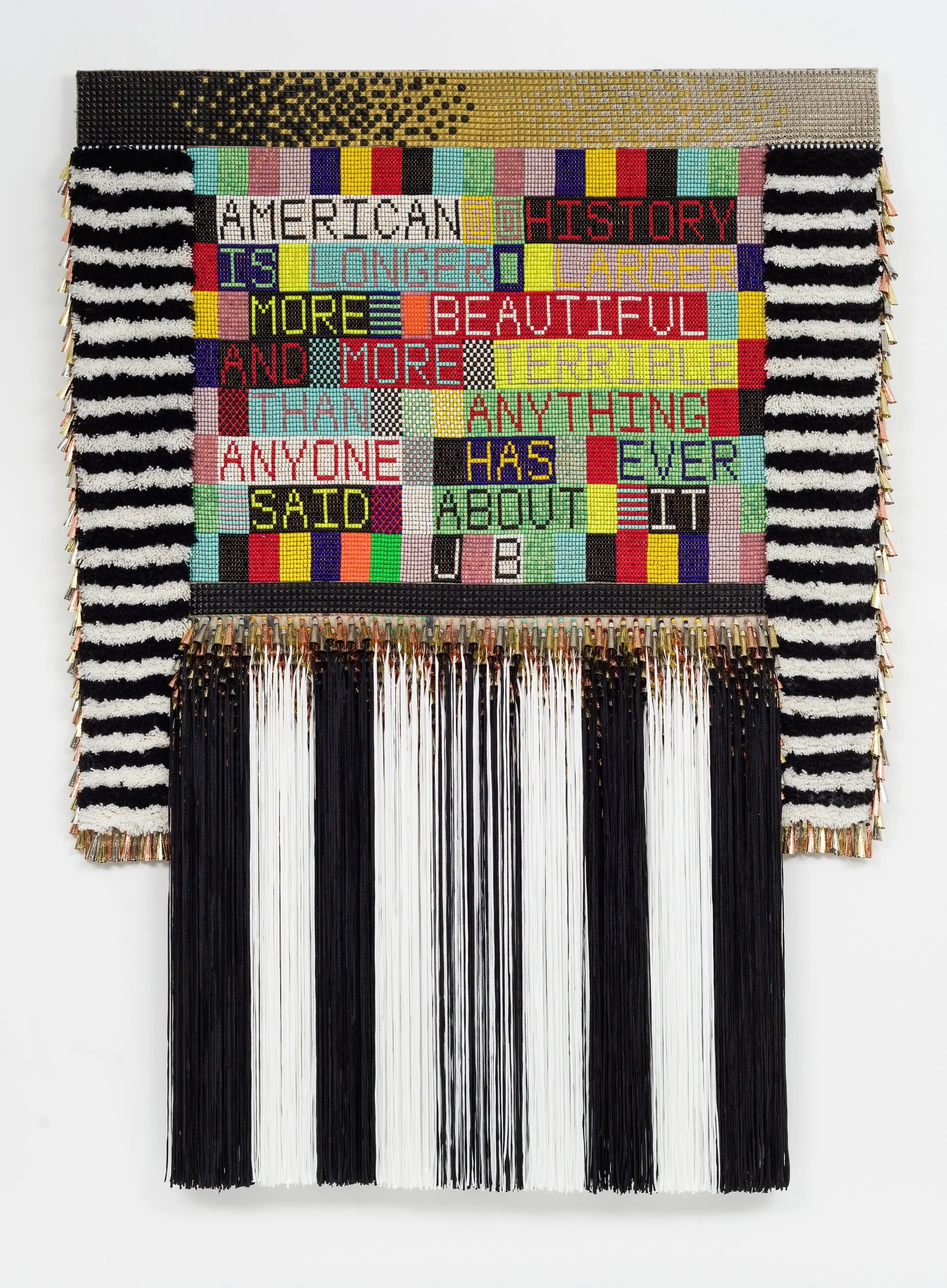
A large-scale beaded textile work by Jeffrey Gibson combines geometric colour blocks with bold text reading, “AMERICAN HISTORY IS LONGER, LARGER, MORE BEAUTIFUL AND MORE TERRIBLE THAN ANYONE HAS EVER SAID ABOUT IT.” The piece incorporates beadwork, patterned fabric panels, and cascading black and white fringe, merging Indigenous craft traditions with contemporary political language.
Jeffrey Gibson, AMERICAN HISTORY, 2015
Wool, steel studs, glass beads, artificial sinew, metal jingles, acrylic yarn, nylon fringe, canvas
226.1 x 167.6 x 12.7 cm / 89 x 66 x 5 in
Courtesy of the artist and Torrance Art Museum
Textile as Cultural Continuity and Protest
Jeffrey Gibson
A queer artist of Choctaw and Cherokee heritage, Jeffrey Gibson works across beadwork, textiles, punching bags, and soft sculpture. His practice draws on Indigenous craft traditions while incorporating protest language, pop aesthetics, and contemporary identity politics.
Gibson’s work challenges Western hierarchies that separate craft from fine art. Textile and beadwork are central to the conceptual framework. In his hands, softness becomes strength, and tradition becomes a vehicle for queer and Indigenous visibility.
Beyond surface embellishment, Gibson’s work treats beadwork and textile as structural language. Colour, pattern, and material density carry political and cultural meaning. By centring Indigenous craft traditions within contemporary art spaces, he disrupts colonial hierarchies while asserting queer presence within those lineages.
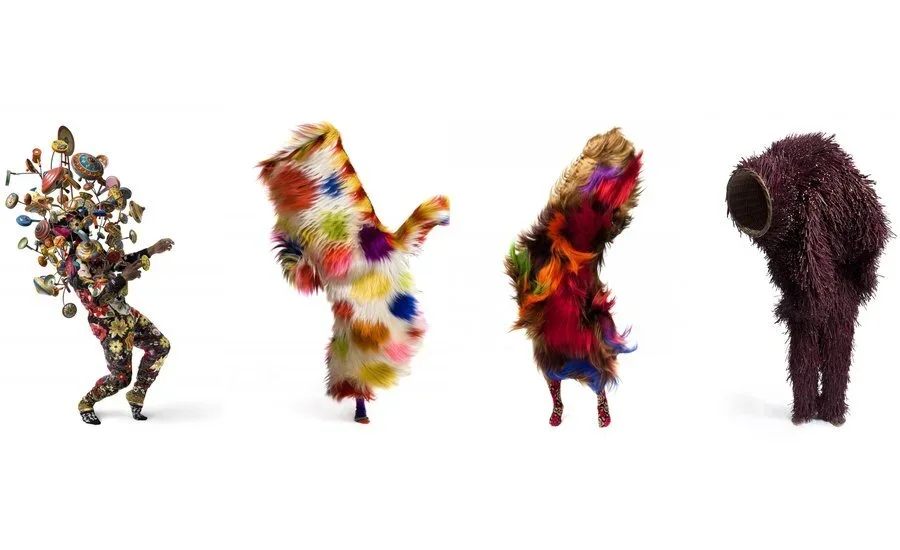
Four of Nick Cave’s Soundsuits are shown against a white background. Each full-body sculptural garment completely obscures the wearer, transforming the figure into an abstract, vibrant presence. Materials include multicoloured faux fur, beads, buttons, and found objects, creating layered textures that blur the line between costume, sculpture, and performance.
Nick Cave, Soundsuits
Hair, metal, raffia, found objects
Courtesy of the artist and Torrance Art Museum
Textile as Armour and Visibility
Nick Cave
Nick Cave is an openly gay American artist best known for his Soundsuits, elaborate full-body sculptural garments constructed from found materials, textiles, beads, buttons, raffia, and fabric. Originally conceived in response to the beating of Rodney King in 1991, the first Soundsuit was created as both protection and protest.
Cave’s work exists at the intersection of textile, performance, and sculpture. The Soundsuits conceal the wearer’s identity, masking race, gender, and class while amplifying movement and sound. In doing so, they transform soft materials into forms of armour. Textile becomes both shield and spectacle.
Across his practice, craft techniques traditionally associated with domestic labour are elevated into monumental, performative structures. The works are intricate and visually exuberant, yet rooted in questions of visibility, vulnerability, and power.
Cave’s practice demonstrates how textile can operate as protection, transformation, and resistance simultaneously.
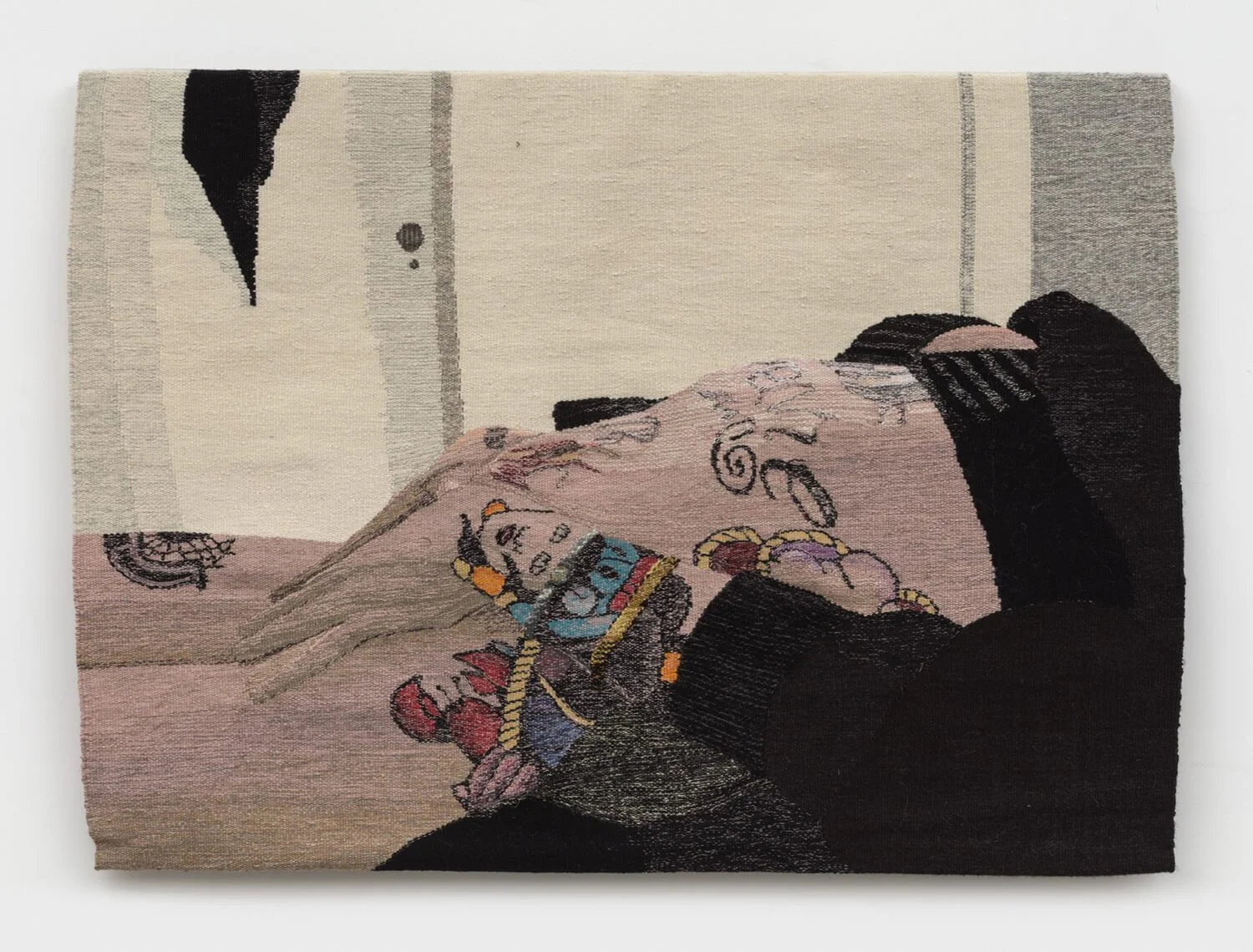
A handwoven tapestry by Erin M. Riley depicts a close-up of a reclining tattooed figure. The textile rendering captures skin tones, inked imagery, and soft shadows through intricate weaving. The intimate framing and careful attention to bodily detail emphasise vulnerability and digital-era self-representation translated into fibre.
Erin M. Riley, Webcam 3, 2020
Wool, cotton, 48" x 35"
Courtesy of the artist
Weaving Intimacy and Vulnerability
Erin M. Riley
Erin M. Riley creates handwoven tapestries that translate intimate, often vulnerable imagery into traditional weaving formats. By working in tapestry, a medium associated with prestige and technical mastery, Riley situates contemporary queer experience within a lineage of craft excellence.
Her work disrupts assumptions about what textile should depict, insisting that vulnerability and sexuality belong within the woven field.
By translating digital-age imagery into handwoven form, Riley slows down images that are typically consumed quickly. The labour of weaving becomes part of the work’s meaning. Intimacy is embedded not only in subject matter, but in the time-intensive act of making.

A close-up of a textile work by Zoë Buckman shows an embroidered portrait partially surrounded by vibrant floral appliqué and stitched detailing. Loose threads remain visible, emphasising process and labour. The work merges softness and strength, combining hand embroidery with imagery that explores gender, power, and bodily autonomy.
Zoe Buckman, Detail of Songs leak from my bedroom wall, 2023
Ink, embroidery, and applique on found textile, 132.7 × 185.1 × 6.4 cm
Courtesy of the artist
Embroidery as Confrontation
Zoe Buckman
Zoe Buckman’s embroidered boxing gloves and textile works bring feminist and queer critique into traditionally masculine spaces. By stitching text onto boxing gloves and soft sculptures, she reclaims embroidery as a tool of resistance rather than decoration.
Her practice demonstrates how textile can operate both symbolically and materially. Softness does not negate confrontation. In many ways, it intensifies it.
By placing embroidered text onto boxing gloves and other objects associated with aggression or masculinity, Buckman stages a confrontation between softness and force. The tension between material delicacy and conceptual directness becomes central to the work’s impact.
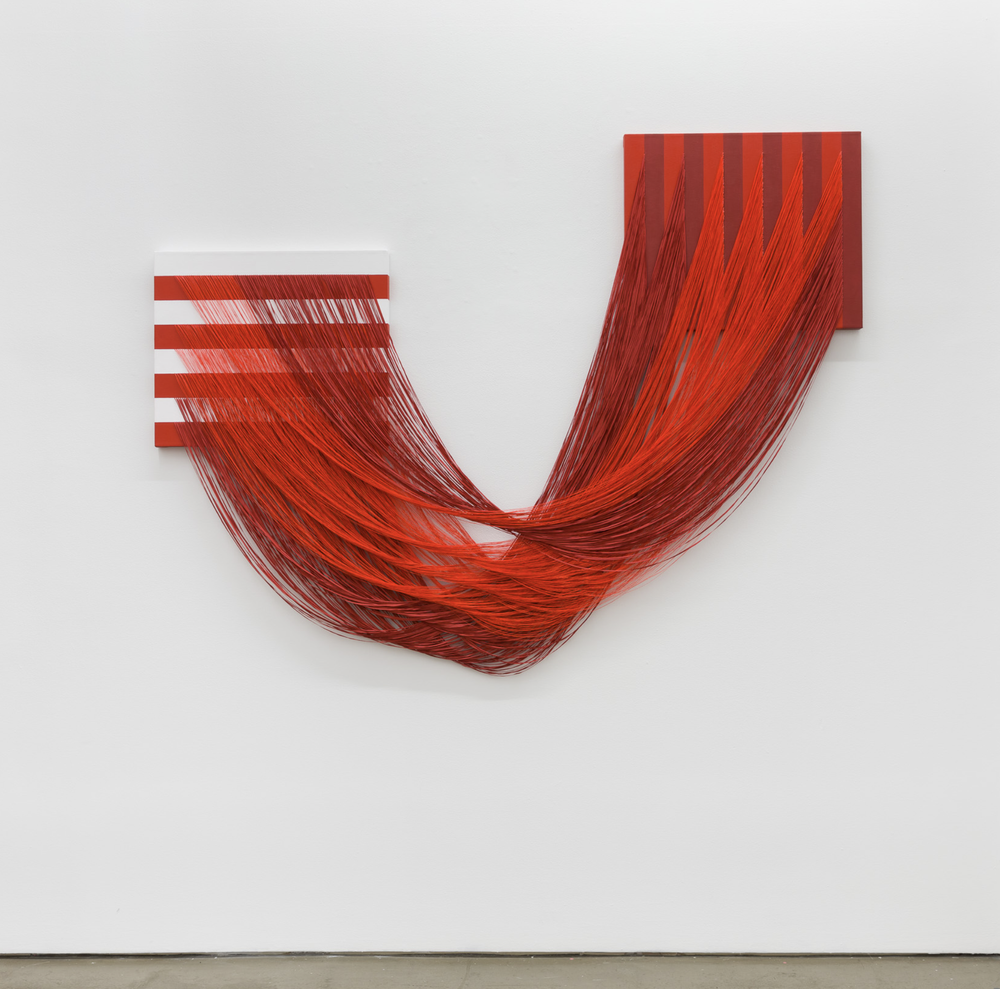
A fibre installation by Liz Collins consists of two wall-mounted geometric panels connected by hundreds of flowing red threads that arc dramatically downward between them. The dense strands create movement and tension, transforming fibre into architectural structure and spatial gesture.
Liz Collins, Satisfaction, 2019
Acrylic on canvas with yarn, dimensions variable
Courtesy of the artist
Textile as Spatial Environment
Liz Collins
Liz Collins expands knitting beyond garment and surface into immersive installation. Her large-scale textile environments transform fibre into architecture.
Collins demonstrates that textile is not confined to domestic scale, but can be immersive, spatial, and monumental. The viewer does not simply look at the work. They move through it.
Her installations blur the line between textile and architecture. Yarn and fibre operate at scale, enveloping viewers rather than sitting passively on the wall. In this context, knitting becomes a spatial and immersive language rather than a domestic one.
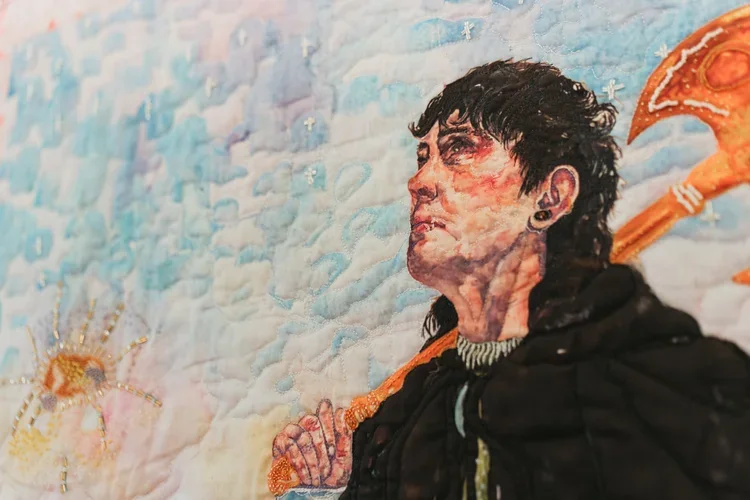
A quilted portrait by Sarah-Joy Ford depicts a figure gazing upward while holding a tool over their shoulder. The background is softly stitched in pale blue, with subtle quilted patterns suggesting clouds or atmosphere. The use of quilting and layered stitching elevates craft techniques into a politically charged, contemporary portrait format.
Sarah-Joy Ford, Detail of The Fool, 2025
Watercolor painting, digitally printed cotton, digital embroidery, hand embellished glass beads and sequins, wadding, plain cotton, long arm quilting, bias binding.
Courtesy of the artist
Quilting as Archive and Community
Sarah-Joy Ford
Sarah-Joy Ford works with quilting, embroidery, and digital stitch to explore queer archives and community histories. Her practice reclaims decorative textile traditions as sites of visibility and record-keeping.
Through layering and embellishment, Ford situates quilting within contemporary queer discourse, connecting archival research to material expression.
Ford’s use of quilting and decorative stitch draws on historical associations with domestic labour and memory-making. By recontextualising these traditions within queer archival practice, she highlights how craft can function as both documentation and reclamation.
Expanding the Field
The artists included here demonstrate that contemporary queer textile practice is not defined by technique alone. It is defined by intention and the decision to let material carry meaning.
Across scale and geography, these practices expand the field by refusing hierarchy. Craft and fine art are not opposites. Softness and strength are not contradictions. Textile becomes structure, body, archive, and environment.
Returning to these works reinforces a simple understanding: material choice is never neutral. It shapes how histories are held, how identities are constructed, and how visibility is negotiated.
In that sense, textile remains one of the most expansive languages available to contemporary queer artists.
For further reading and research on the artists listed in the article above, please view the following links:
Jeffrey Gibson: https://www.hauserwirth.com/artists/jeffrey-gibson
Nick Cave: https://nickcaveart.com/Main/Intro.html
Erin M. Riley: https://erinmriley.com/home.html
Zoe Buckman: https://www.zoebuckman.com
Liz Collins: https://www.lizcollins.com
Sarah-Joy Ford: https://sarahjoyford.com
