
In Response to the AIDS Memorial Quilt: A Collaboration with Queer Britain
This post is part of a Collaboration Spotlight series, reflecting on the organisations I collaborate with and why these relationships matter so deeply to my work. To begin, I want to share the collaboration I’ve just undertaken with Queer Britain.
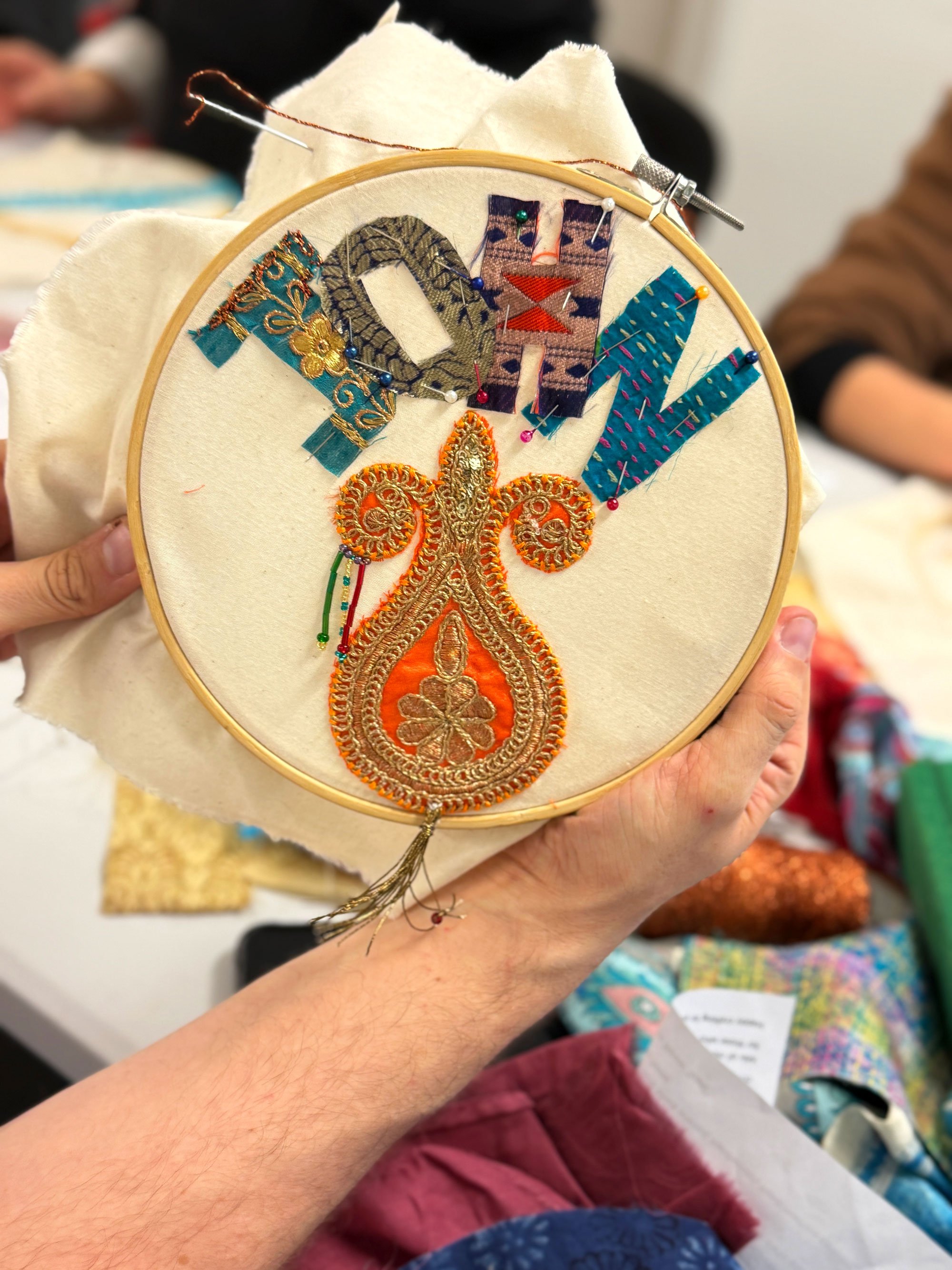
Two hands hold an embroidery hoop featuring layered fabric letters spelling “JOHN.” Beneath the letters, an ornate gold appliqué motif with orange detailing anchors the composition. Pins remain visible in the fabric, revealing the work mid-process — an interplay between structure, decoration, and experimentation.
Why Community Partnerships Matter
Community partnerships are essential to my practice because they open up new possibilities for connection. Together, something becomes possible that could not exist independently. Organisations like Queer Britain hold space for people not just physically, but within an important cultural and historical context. They offer environments where participants feel recognised, understood, and welcome as they are.
When creative workshops take place within these spaces, something shifts. The focus moves toward presence and intention. People arrive not to prove anything, but to explore materials, make marks, and sit with process at their own pace. That sense of ease changes how people relate to making, and to each other.
For me, partnering with community organisations is also about responsibility. As an artist working with themes of identity and healing, it matters where and how that work is shared. Collaboration ensures that workshops are responsive rather than imposed, shaped by the needs of the community rather than external agendas.
These partnerships allow art-making to become relational. A shared experience rooted in slowness, respect, and openness. They remind me that creativity does not need to be extracted or elevated to be meaningful. Sometimes its most powerful role is simply to exist alongside people, slowing down together and letting connection unfold.
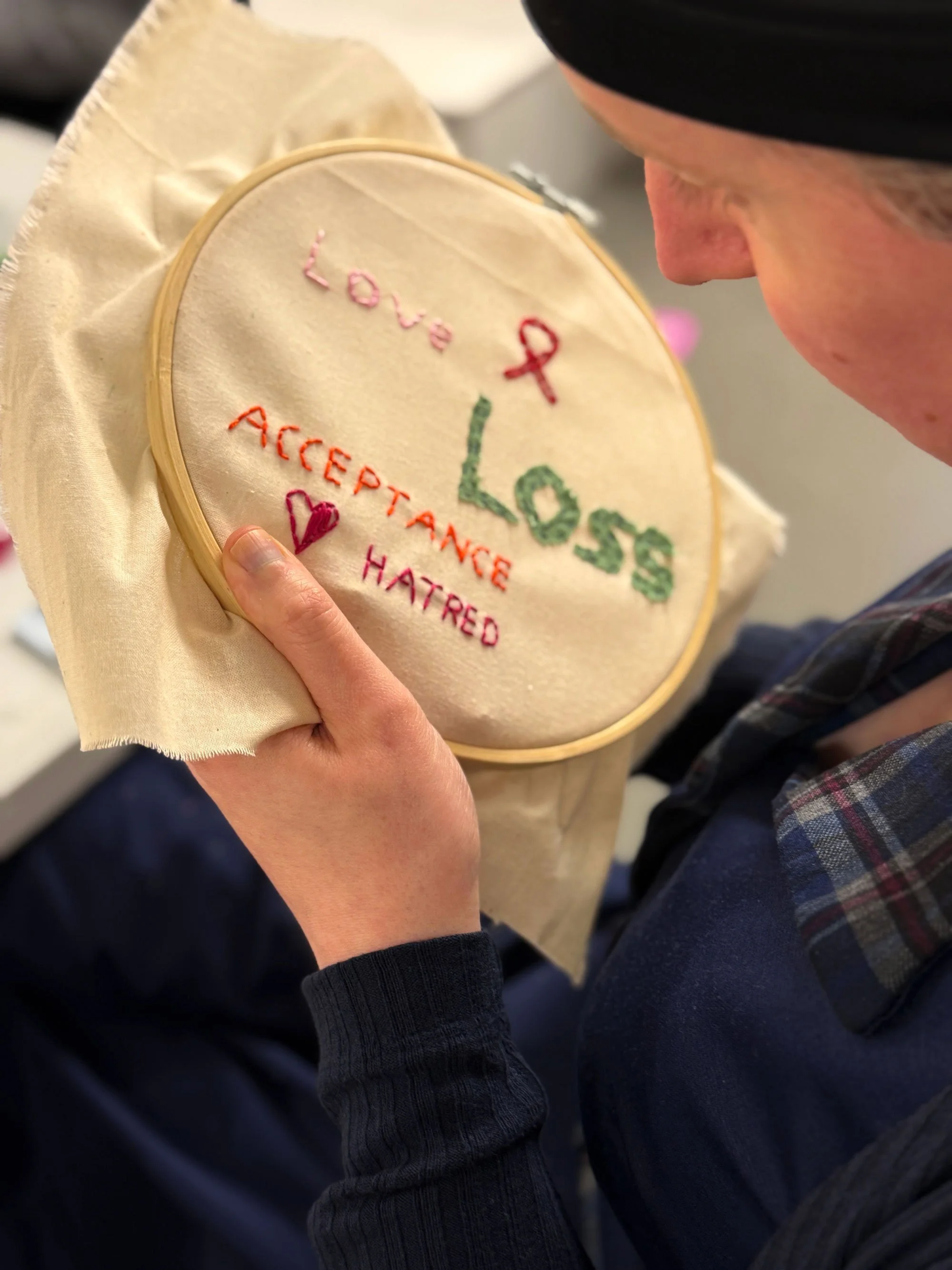
A participant carefully holds an embroidery hoop stitched with the words “Love & Loss” in contrasting pink and green thread. Beneath, smaller stitched words — “Acceptance” and “Hatred” — appear in red and orange, accompanied by small symbolic details. The piece reflects layered emotional responses, held within the intimate circular frame of the hoop.
Collaboration Spotlight: Queer Britain
For this collaboration, I worked with Queer Britain, the UK’s first national LGBTQ+ museum. Queer Britain exists to celebrate, preserve, and share queer histories, stories, and lived experiences from the past, present, and future.
What draws me to Queer Britain is not only the importance of their archive, but the way they embrace complexity. Their collection recognises that queer history is not singular or linear, but layered, multigenerational, intersectional, and deeply personal.
Hosting a creative workshop within a space dedicated to queer history felt especially meaningful. It allowed contemporary acts of making to sit alongside archival narratives, creating a quiet dialogue between what has been held, what is still emerging, and what is yet to be named. In this context, making becomes both a response and a continuation.
This collaboration is rooted in shared values around accessibility, care, and community-led engagement. Rather than positioning art-making as something to be observed from a distance, the workshop invited participation, slowness, and reflection. These qualities feel deeply aligned with both my practice and Queer Britain’s wider mission.
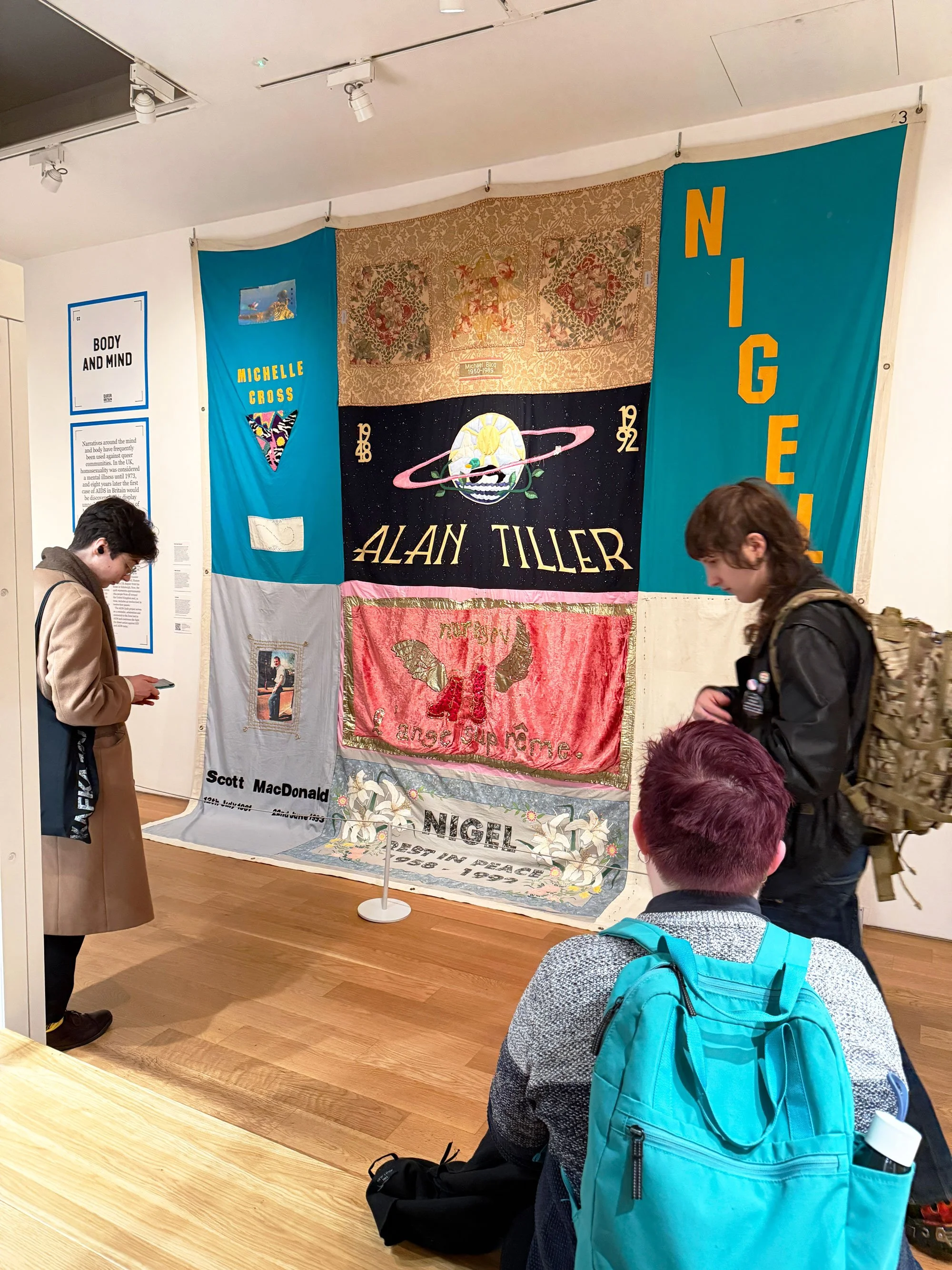
Visitors stand and sit quietly in the gallery space at Queer Britain, viewing a large panel from the AIDS Memorial Quilt displayed against the wall. The quilt features multiple stitched sections, including names, decorative motifs, and fabric panels in teal, pink, and patterned textiles. The scale of the quilt dominates the space, drawing attention to its commemorative presence. Interpretive panels are visible on the surrounding walls, situating the work within the museum’s wider exhibition context.
What Makes This Collaboration Special
What made this collaboration feel particularly special was the intentionality behind it. From the outset, the workshop was shaped with care, not only around what would be made, but around how people would be welcomed into the space.
The workshop took place at the start of February, marking both the reopening of Queer Britain and LGBTQ+ History Month. The gallery space welcomed a new addition, The AIDS Memorial Quilt, Panel 23.
We began in the gallery, silently taking in the quilt panel, which features eight individual panels stitched together to represent lives lost. Serving as both memorial and reminder of the continued fight against HIV and AIDS, the scale of the work was larger than many expected.
One attendee noted quietly to me:
“I expected each quilt to be smaller. They are much larger than I thought.”
I reflected back that the quilt calls to mind the size of a human body, or even a coffin.
Later in the workshop, Karina Thompson, a textile artist and AIDS Quilt UK volunteer, confirmed that each panel measures approximately three by six feet. The size was intentionally designed to reflect the average dimensions of a grave plot.
After spending time in the gallery, we returned to the workshop room to reflect on our experience.
Participants worked with scrap and reclaimed materials, exploring words, phrases, memories, and ideas in response to the quilt.
Themes of evolving grief, joy, celebration of life, and remembrance surfaced throughout the afternoon. The space felt open and welcoming, with a pressure-free atmosphere where participants were encouraged to explore materials intuitively, without expectation of outcome.
There is something powerful about making together within a space that actively honours queer lives and histories. The act of stitching, reworking, and assembling materials became a collective gesture. A way of taking time. A way of remembering and honouring.
Throughout the workshop there was a wide range of sound, from quiet reflection to laughter and conversation. People shared deeply personal stories in response to the quilt. They spoke about grief, separation from family, and loved ones who have been lost. Alongside this, there were glimmers of hope and celebration of life.
One participant stitched the words, “What once was and what could have been.” The phrase felt poetic, tender, and full of longing all at once.
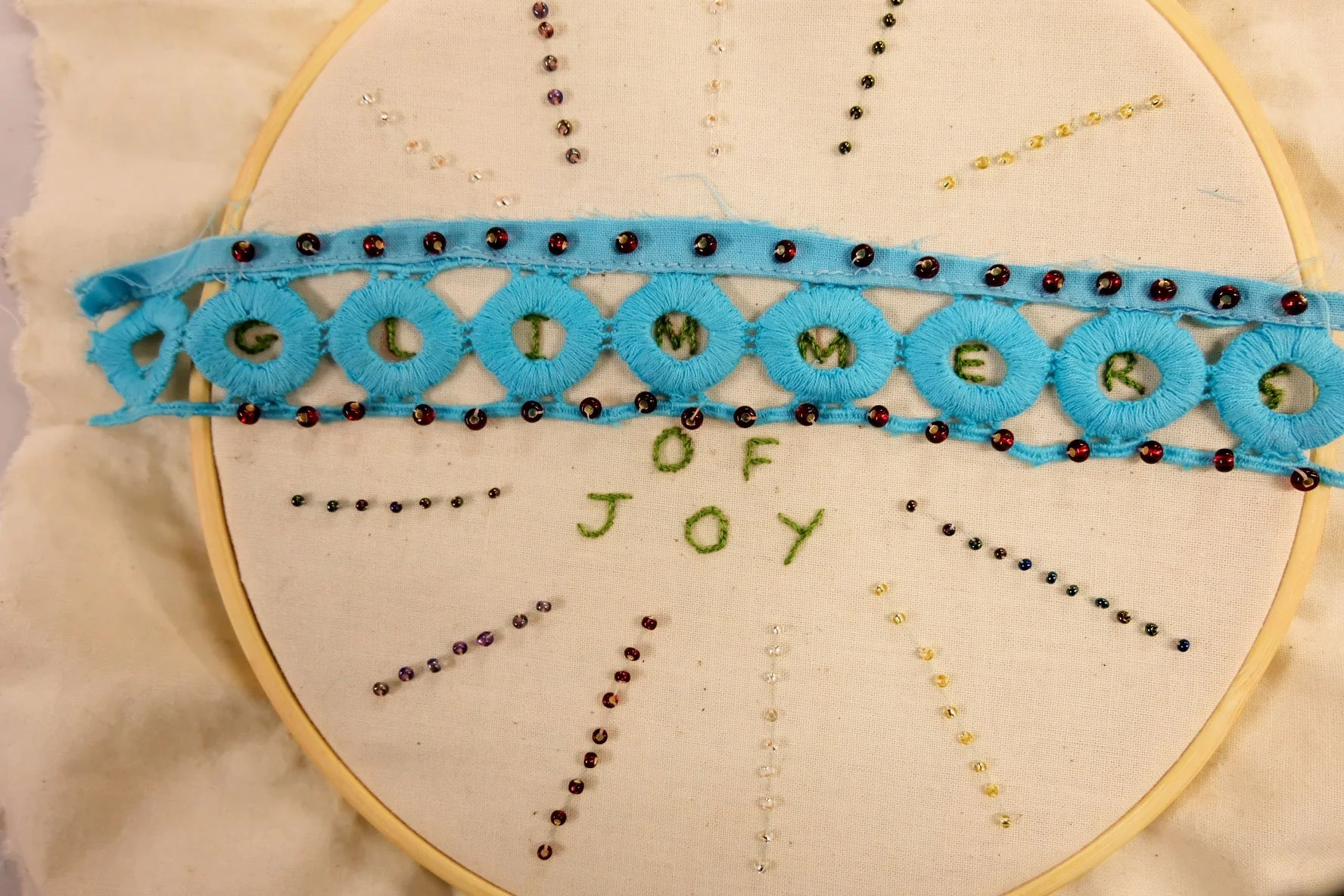
A close-up of an embroidery hoop displaying the stitched words “Glimmers of Joy” in green thread. A band of bright blue lace, embellished with red beads, runs horizontally across the fabric. Small clusters of beads radiate outward like soft bursts of light, creating a sense of celebration and quiet luminosity within the circular frame.
Closing: Looking Ahead
Collaborations like this remind me why I began reaching out to my community to create workshop programming in the first place. I wanted to feel less alone. Rather than existing in isolation, I wanted my practice to be rooted in shared space.
This experience with Queer Britain represents what I hope for when art enters communal space. Openness. Attentiveness. Room for people to show up just as they are.
I hope to continue developing projects in response to queer history, current affairs, resistance, and collective presence. Encouraging people’s voices through craft and skill sharing is something I know I will continue to do, because the spark I see in someone after they have engaged in a workshop feels invaluable.
As my practice continues to evolve, I remain committed to working in partnership with organisations that prioritise accessibility, inclusivity, diversity, and community-led engagement. Spaces that understand creativity not as output, but as process. Not as spectacle, but as connection.
These moments of making together stay with me long after the materials are packed away. Thank you to everyone who was involved.
Future Collaborations
If you are part of a community organisation, cultural space, or collective interested in collaborating on a values-aligned project, I would love to hear from you. I am always open to conversations around workshops, long-term partnerships, and creative projects rooted in healing, slowness, and shared making.
You can get in touch via my website contact page or keep an eye on upcoming collaborations and workshops as they are announced.
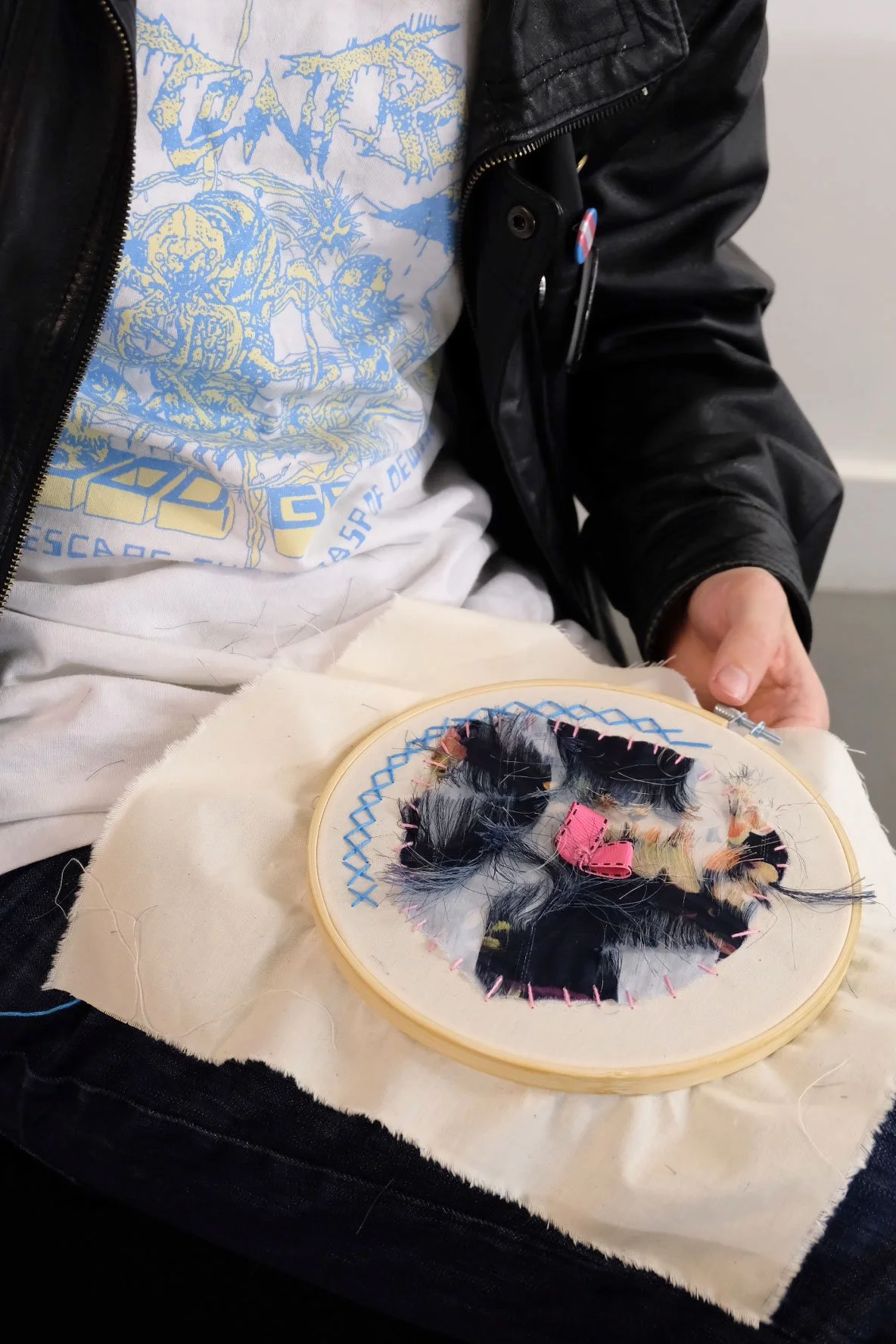
A participant sits with an embroidery hoop resting on their lap, working with layered reclaimed materials. Black feathers, pink ribbon, and stitched blue thread form a textured circular composition. The tactile materials sit against neutral fabric, highlighting the exploratory and intuitive nature of the workshop process.
