
One Year of Teaching: How Workshops Reshaped My Practice
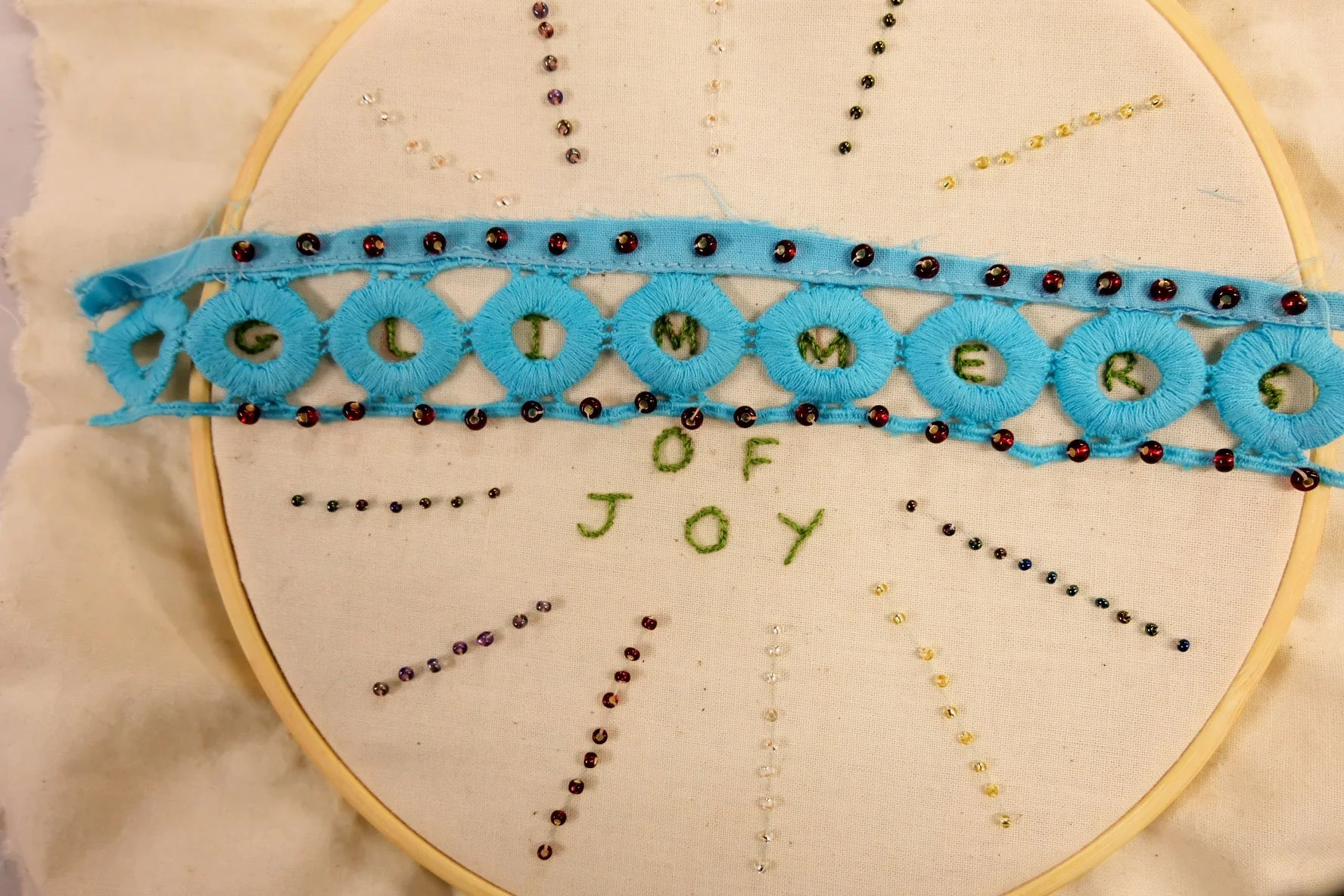
A circular embroidery hoop displays stitched green lettering spelling “Glimmers of Joy” beneath a band of bright blue fabric embellished with red beads. Radiating lines of small, multicoloured beads extend outward across the neutral fabric background, creating a subtle starburst effect. The composition feels celebratory yet carefully handmade, with visible stitching and layered textile textures.
I didn’t start teaching workshops to become an “expert.” I started because I wanted to make space. Space for play, for experimentation, and for people who didn’t always feel welcome in traditional art settings to reconnect with creativity on their own terms.
When I began teaching workshops in April 2025, it wasn’t part of a long-term plan. It grew from a desire to share the processes I was already exploring in my studio: slow, tactile, imperfect ways of working, and to see what might happen when those processes were opened up and shared collectively.
One year on, I have been reflecting on what that decision has changed. Not only in how I facilitate workshops, but in how I relate to my own work, my materials, and the role creativity plays in my life. This is a reflection on that first year of teaching: what I hoped to offer, what I learned along the way, and how making space for others reshaped my own practice in return.
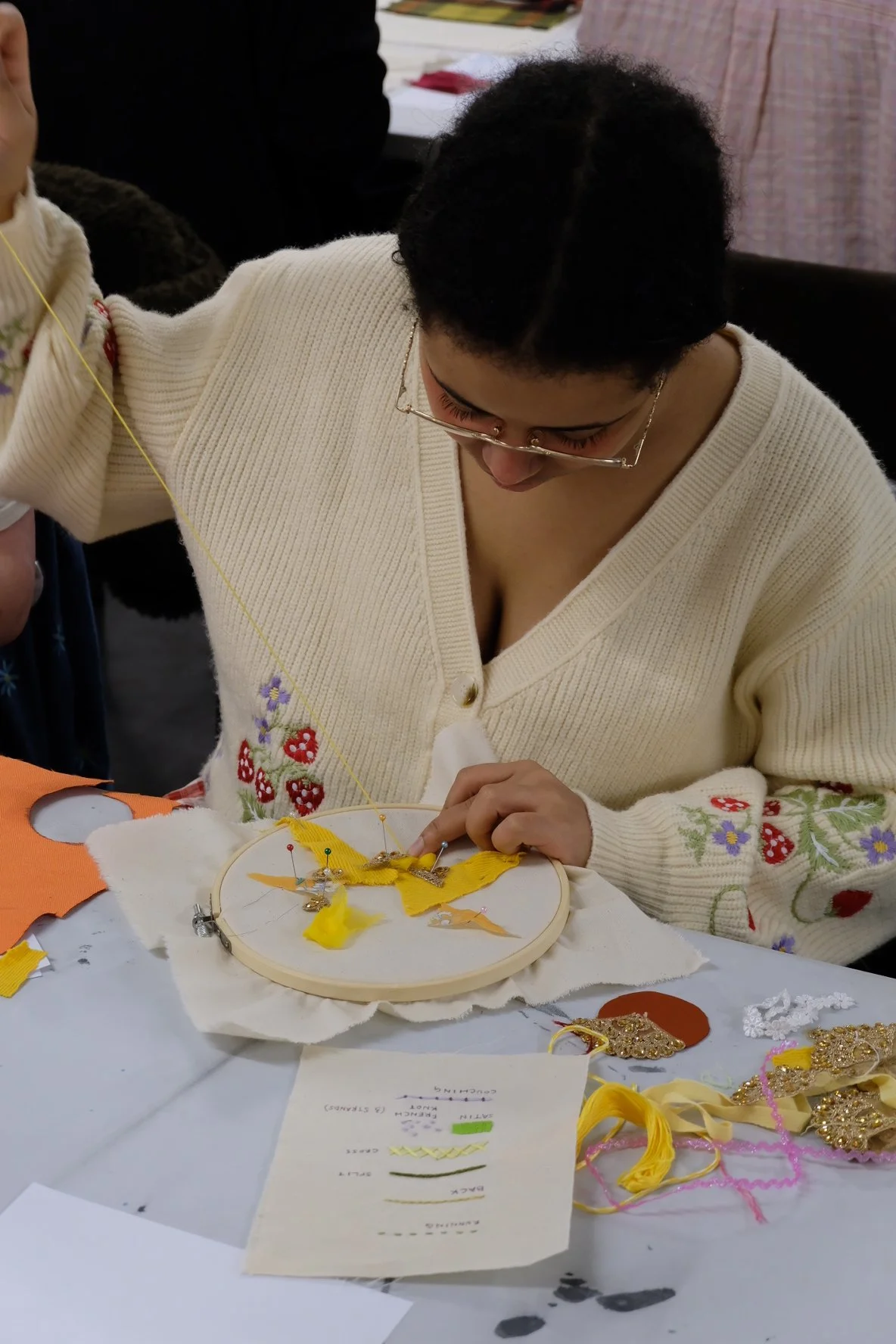
A close-up view of a participant concentrating on hand-stitching yellow fabric inside an embroidery hoop. The table in front of them holds colourful threads, decorative trims, and sample stitch references. Their posture suggests careful attention to the material and process.
How Teaching Reshaped My Practice
Teaching workshops reshaped my practice by slowing me down and widening my perspective. Holding space for others made me more aware of how deeply connected we are, and how much creativity is shaped by relationship.
Facilitating workshops required me to loosen my grip on productivity and outcomes. In those spaces, attentiveness coexists with openness. Processes unfold differently for each person, and there is no singular result to guide toward. Resisting the urge to steer outcomes softened something in my own studio practice.
Watching participants work reminded me how instinctive creativity can be when it is not weighed down by ideas of skill or productivity. People approached materials with curiosity, hesitation, confidence, or care. Seeing these varied relationships helped me notice where I had quietly placed limits on myself, and where I could soften my own expectations.
Teaching also brought me back to fundamentals. Preparing sessions meant returning to simple stitches, repetitive gestures, and basic tools. Bringing things back to essentials helped me recognise their quiet power.
It also shifted my understanding of authorship. Making alongside others reframed creativity as relational rather than solitary. Art does not have to exist solely as a finished object. It can live in shared moments, in conversation, in the act of paying attention together.
One unexpected shift was learning to ask for help. Supporting others in their creative journeys made it clearer how much can be gained through guidance and collaboration. That realisation carried back into my studio, where I sought mentorship and support while applying for an art funding grant. Reaching out became part of the practice itself.
Watching participants arrive also reshaped my sense of what is “enough.” I often thank people simply for showing up, especially when they come alone. Choosing to set aside time for yourself, to be present and to make in the company of others, is a vulnerable and quietly brave act. Witnessing that courage has influenced how I measure value in my own work: not by output, but by presence, intention, and care.
One year in, teaching has not pulled me away from my practice. It has folded back into it.
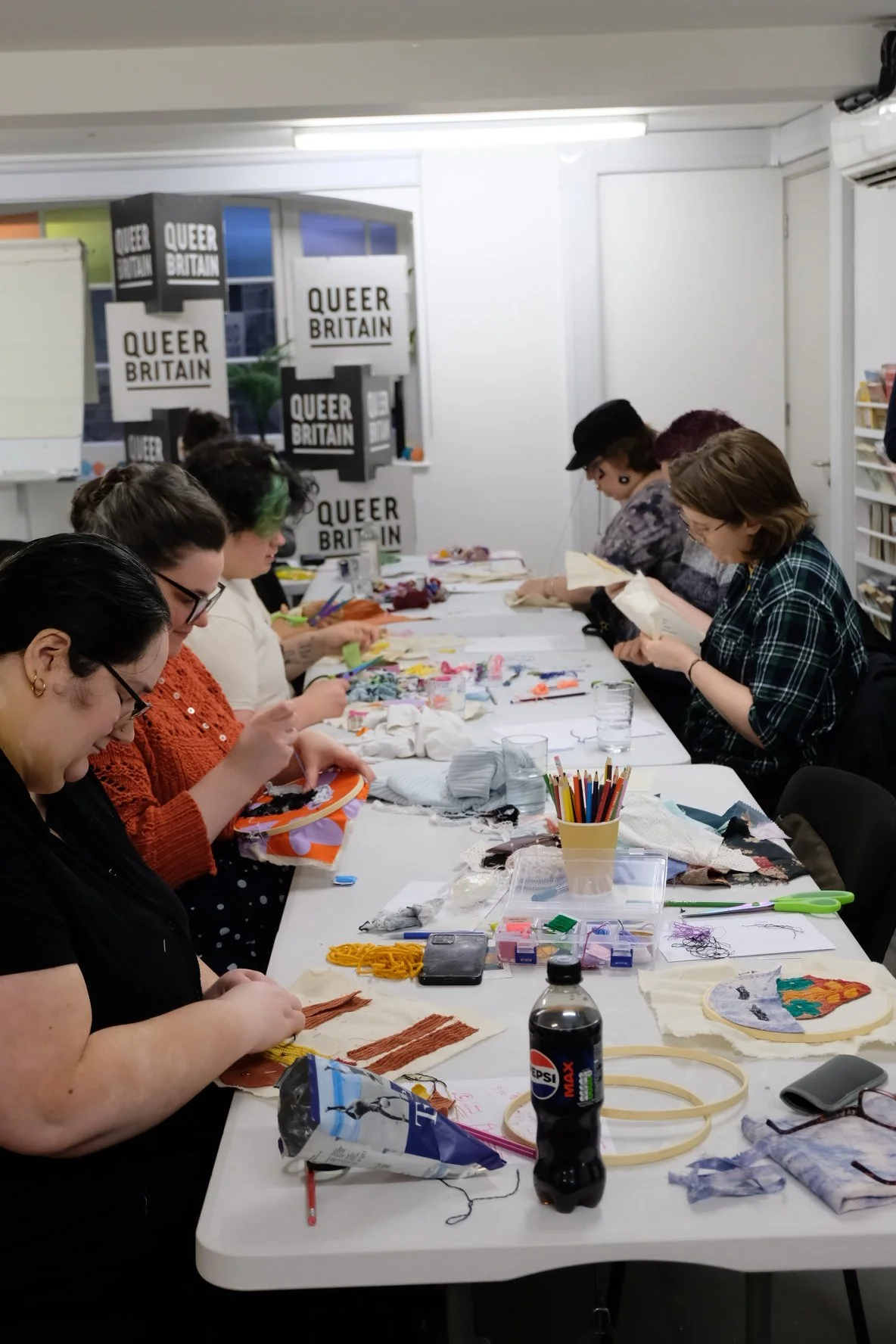
A group of workshop participants sit around a long table covered in fabric scraps, embroidery hoops, thread, and tools. Each person is focused on their own textile piece while working quietly together. Queer Britain signage is visible in the background, situating the workshop within the museum space.
Demystifying Art-Making
From the beginning, I was particularly interested in demystifying stitching and embroidery. These practices are often perceived as technical, delicate, or requiring mastery. Many participants arrive apologising for their lack of experience, or downplaying any previous engagement with craft.
I wanted to undo the idea that there is a correct way to make. That creativity requires premium materials or prior training. That mistakes signal failure.
In workshops, I invite people to begin somewhere. Choose one colour. Pick one piece of fabric. Make one stitch. Decision-making can unfold slowly from there. The emphasis is not on perfection, but on attention.
Materials become approachable when they are treated as forgiving. Thread can be unpicked. Fabric can be layered. Nothing has to be final.
Over time, I realised that speaking this language aloud for others strengthened my own relationship to making. Encouraging participants to approach materials with curiosity and compassion reinforced that same generosity in my studio. The act of demystifying craft for others quietly demystified parts of my own practice too.
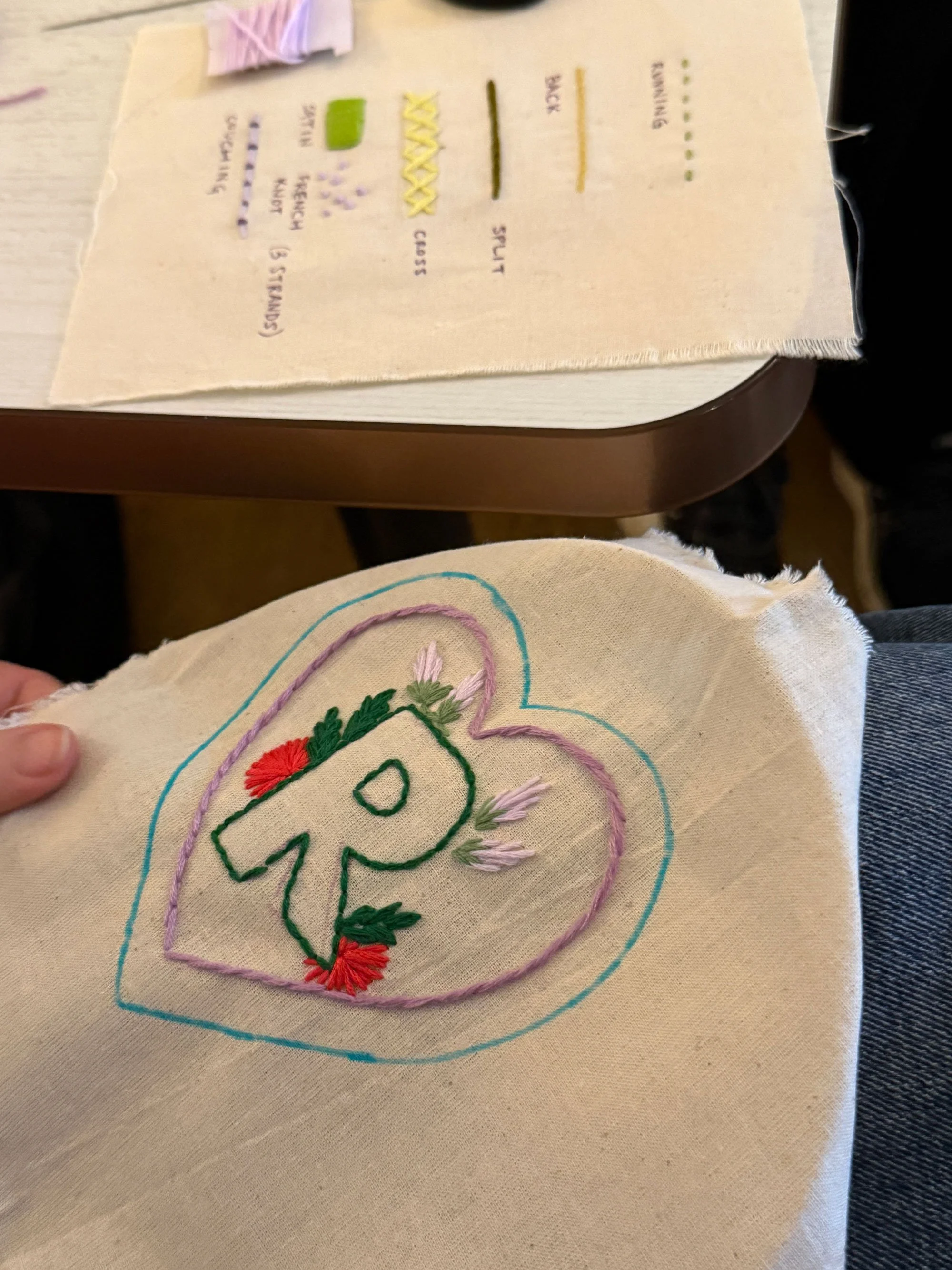
A piece of fabric rests on a participant’s lap, featuring a heart-shaped outline stitched in purple and blue thread. Inside the heart, green embroidered initials are surrounded by small red and pink floral motifs with leafy details. In the background, a stitch reference sampler sits on the table, showing examples of different embroidery techniques. The image captures a quiet, close-up view of a work in progress, highlighting texture, colour, and handwork.
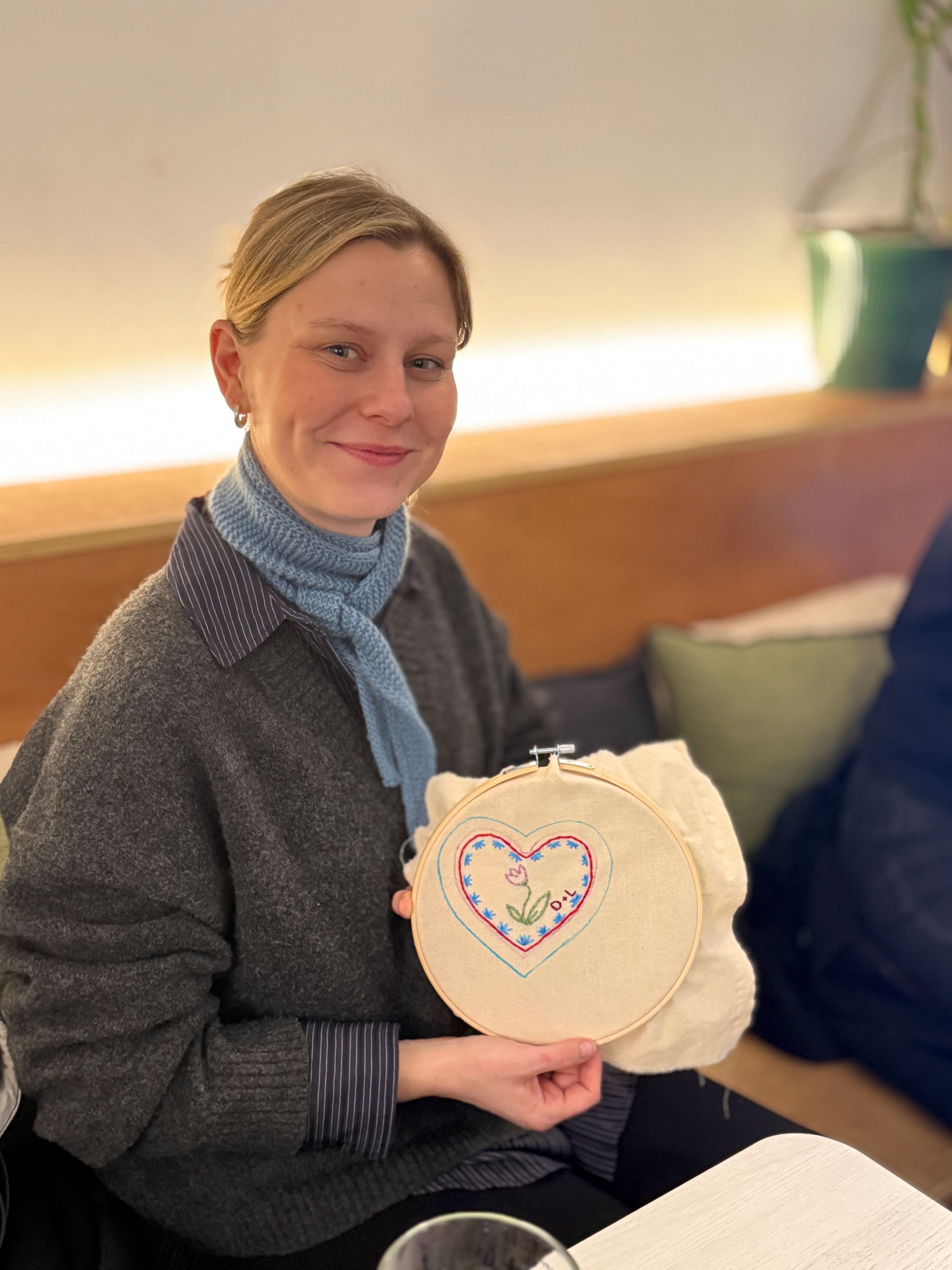
A participant holds up their finished embroidery hoop featuring a heart-shaped design stitched in blue and red thread. They sit indoors against a softly lit background, presenting the completed piece with a gentle expression. The image captures a quiet moment of pride and reflection at the end of the workshop.
What I Hoped Participants Would Take Away and What They Gave Back
When I began teaching, my hopes were simple. I wanted people to feel welcome and less alone. I wanted them to feel permission to experiment, to be unsure, to move slowly, and to make without needing to justify the outcome.
I did not set out to teach people how to produce “good” work. The intention was always to offer an experience that prioritised process over result and curiosity over confidence.
What I did not anticipate was how much participants would give back in return.
Through quiet conversations and post-workshop reflections, people spoke about feeling calmer, more grounded, or surprised by what they enjoyed. Some mentioned how long it had been since they last made anything with their hands. Others reflected on how freeing it felt to work without comparison or pressure.
These responses reinforced something I had sensed but had not yet articulated: creating environments of encouragement can be just as meaningful as teaching technique. Being present and attentive can shift how people relate to creativity, even in subtle ways.
The workshops became an exchange rather than a one-way offering. Participants arrived with their own histories, hesitations, and instincts, and those collective presences shaped the space as much as I did.
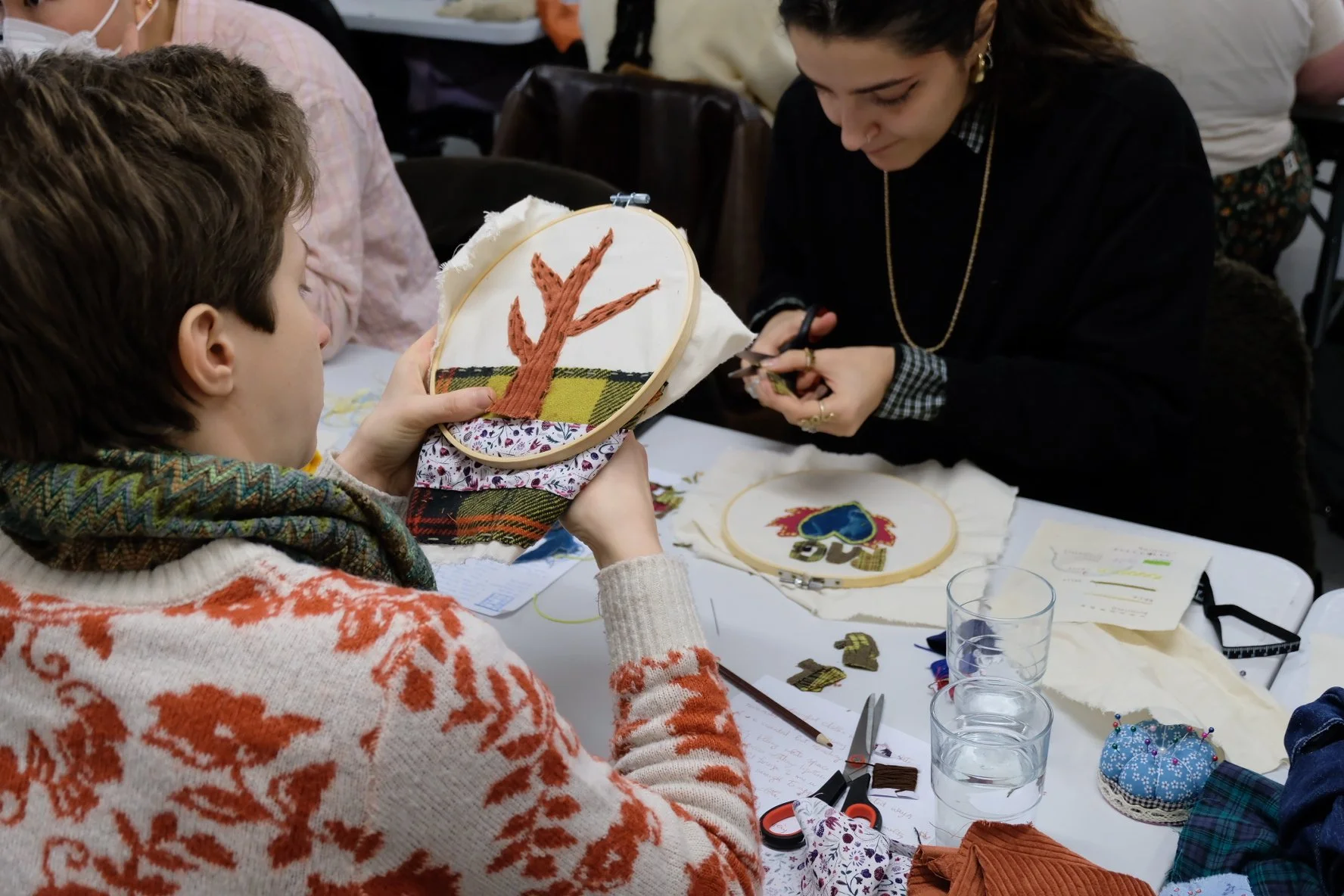
Two workshop participants sit opposite one another, each holding an embroidery hoop. One works on a tree motif stitched onto layered fabric, while the other trims materials with scissors. Scraps of patterned cloth, thread, and tools are scattered across the table, reflecting the tactile, hands-on nature of the session.
One Year On
One year after teaching my first workshop, I feel more grounded in why this work matters to me. Teaching has become less about instruction and more about attention. It is about noticing what emerges when people are given time, materials, and permission to explore on their own terms.
This year has shown me that accessibility in art does not come through simplification, but through care. Through environments that are welcoming and responsive. Through the understanding that making can hold many meanings, none of which need to be fixed or final.
As I continue teaching alongside my studio practice, I want to remain attentive to that openness. Creating space is not a one-time gesture. It is an ongoing practice.
If you are interested in experiencing this kind of space firsthand, I continue to offer workshops throughout the year. They are open to all levels of experience and centre process, attention, and collective making.
You are warmly welcome to join whenever it feels right.
